Address
P.O. Box 791
Boulder, CO 80306
303-441-3440

About Us

Bookmark and Share Print

Boulder's Open Space & Mountain Parks:
A History

Menu - Learn More about OSMP and its History

Innovation at the Grassroots

Boulder's Open Space & Mountain Parks program is the product of a long history of actions taken by the City of Boulder government and the people of Boulder in response to their concern for the preservation of buffer areas and the mountain backdrop.

In 1898, when the Boulder Valley stretched wide and mostly unspoiled from the Front Range of the Rocky Mountains to the far horizon of the plains, residents of the young community of Boulder began preserving land. Their first purchase was the alfalfa fields and apple orchards planted by the Batchelder family, the lovely area now known as Chautauqua Park.

Photo - Batchelder Ranch, pre 1898


Photo - Batchelder Ranch prior to 1898. Note the entrance to Gregory Canyon behind the windmill. The Batchelder ranch house still stands next to the fountain garden at Chautauqua.


That purchase, paid for with a bond issue, was followed in 1907 with a federal grant of 1,600 acres of land on Flagstaff Mountain. In 1912, Boulder citizens  purchased another 1,200 acres of the mountain for  $1.25 an acre!

The community cared for its new property. The Lions Club built a shelter at Panorama Park in 1919 and at Bluebell in 1923. The stone Flagstaff Summit Shelter was built in 1933 by the Lions. During the 1930s, the Depression-era Civilian Conservation Corps built the popular Sunrise Amphitheater, Green Mountain Lodge and a new shelter at Panorama Park. The Jaycees built a picnic shelter on Flagstaff and several other community groups pitched in to build and maintain trails, fences and other facilities. Volunteers patrolled these Mountain Parks properties until 1970, when the City of Boulder hired its first full-time ranger.

Land Preservation Heats Up

As Boulder's population doubled between 1950 and 1960, concerned citizens form an action group known as PLAN Boulder County. The group has successfully campaigned for many important land preservation and land use issues. In July 1959, a charter amendment was passed, establishing a "blue line" above which city water would not be supplied. Citizens who helped pass the issue realized that this would slow development of the foothills, but not stop it. Photo - Wildflower meadow on Enchanted MesaIn 1964, a local developer decided to construct a luxury hotel facility on Enchanted Mesa, an elevated parcel of natural land over looking Boulder from the west. Outraged citizens organized to protest the development, and the City Council voted to condemn the land and force its sale. Activists raised small donations from the community bit by bit until they reached the purchase price. The land became part of Boulder's Mountain Parks system and you can hike there today.

Photo - Orange Arnica in bloom on Enchanted Mesa, which almost became the site of a luxury hotel in 1964.


Citizen involvement in the open space preservation effort continued with public education a major focus. Boulder's City Council lent its support to the effort. A conference was sponsored by PLAN Boulder County to further educate the public. "Greenbelts, why and how" included speakers from the city and county government, Colorado Open Space Council, Bureau of Outdoor Education, planning consultants and other interested groups. Committees were formed, slide programs presented, and local drivers sported bumper stickers supporting the greenbelt issue.

Image - Original 1967 poster for Greenbelts campaign.In 1967, Boulder voters made history by approving a 4/10 of a cent sales tax specifically to buy, manage and maintain open space, the first time citizens in any U.S. city had voted to tax themselves specifically for open space. The sales tax measure passed by a 57% majority, an overwhelming demonstration of support in an era of citizen tax concern.

Image - Original 1967 poster for Greenbelts campaign.

Shortly after the election, the City Manager and City Council appointed an Advisory Committee on Open Space. As the open space acreage grew, responsibility for managing and maintaining the land was placed with the Parks and Recreation Department.  In 1973, citizen activists successfully called  for the creation of a separate Open Space Department focused on acquiring and maintaining natural land. The City Council created the Open Space Board of Trustees to set policies and priorities for acquisition of greenbelt lands.

In 1989 76% of voters added 3/10 of one cent to the sales tax for a period of 15 years to accelerate open space preservation. The sales tax revenues, coupled with passage of a charter amendment in 1971 allowing City Council to issue bonds for the acquisition of open space, set into motion an aggressive open space acquisition program. Bonds were again issued in 1980, 1984 and 1989, and in 1986 a charter amendment providing more permanent protection for open space lands was adopted with passage by 79% of the voters.

The Boulder Valley Comprehensive Plan, adopted by the city and county in 1978, recognizes open space as providing the basic structure for the Plan. Purposes for open space include: preservation or restoration of natural areas; preservation of water resources in their natural or traditional state; preservation of scenic areas or vistas, wildlife habitats, or fragile ecosystems; preservation of land for passive recreational use; preservation of agricultural uses and land suitable for agricultural production; utilization of land for shaping the development of the city; utilization of non-urban land for spatial definition of urban areas; utilization of land to prevent encroachment on flood plain's; and preservation of land for its aesthetic or passive recreational value and its contribution to the quality of life of the community.


Photo - Chickaree SquirrelTwo Agencies Merge

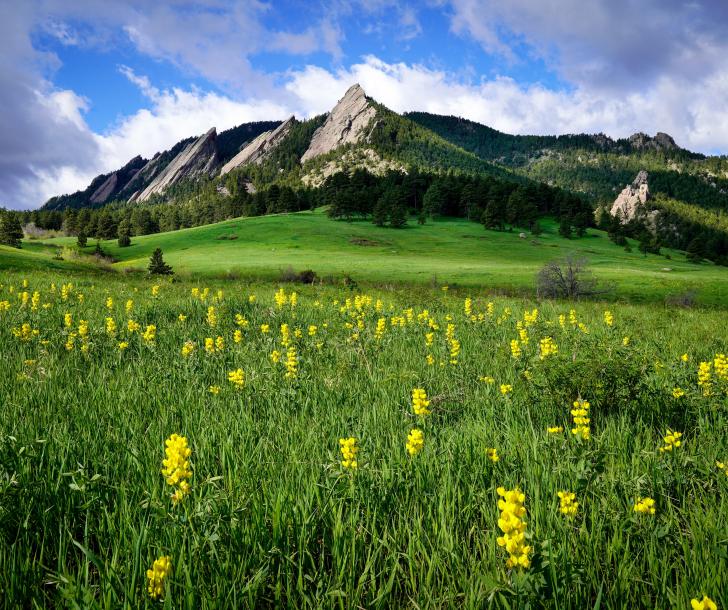
In January of 2001, the City of Boulder Mountain Parks Division—under the Department of Parks and Recreation—and the Open Space/Real Estate Department merged to form one new department to manage the city’s wild recreational lands. The new department, named Open Space and Mountain Parks, retained the city’s real estate division and brought together the functions of both the former Open Space and Mountain Parks groups. The long name acknowledges the long history of each agency, as well as the philosophies, staff and the supporters of the two organizations.Photo - When the city's Mountain Parks Division merged with the Open Space & Real Estate Department, the land in the foreground (Open Space) and the background (Mountain Parks) were unified under one new agency. With the parallel missions, overlapping functions and similarities in staffing, merging Open Space and Mountain Parks had been a topic among city policymakers, boards and the public for many years. The merger allowed the new department to provide a more consistent range of visitor opportunities and regulations on the ground, save money by eliminating some duplication, and bring the 6,555 acres of Mountain Parks lands—including Boulder’s signature Flatirons—under the strict protections of the Open Space Charter. OSMP Today

Photo - biking on Mashall MesaToday, Boulder citizens enjoy over 45,000 acres of city open space land in and around the city. Some of the land is in agricultural production, preserving the historic cultural landscape of Boulder County while keeping the land open for wildlife and passive recreational uses. In addition to the aesthetic pleasure of Boulder's Open Space & Mountain Parks, an extensive trail system is available for hikers and horseback riders. Bicyclists enjoy riding on designated trails. Picnicking and fishing areas also appeal to area residents, as well as a variety of free educational programs conducted by Open Space & Mountain Parks staff.

With annual visitation of 5.3 million per year, maintenance is becoming increasingly important to preserve the quality of Boulder's Open Space & Mountain Parks.

Menu - Learn More about OSMP and its History

Want to learn more? Follow this link to Amazing Facts for more surprises!

Watch the Open Space & Mountain Parks Video (Real Media format)

Clicking any flag icon above calls Google translation service to translate the page to the language you have chosen. Graphics containing text, PDF files, and special applications on this page cannot be translated. As with any computer translation, conversion is not context-sensitive and may not convert text into its intended meaning. The city of Boulder does not guarantee the accuracy of translated text. If the information you are seeking is not clear please return to the main page for the specific city department and contact them directly. Please note that some applications and/or services may not work as expected when translated.

Plugins needed for this Web site: [ Adobe Reader ] [ Flash Player ] [ Quicktime ] [ Real Player ]