Department Information
Click to jump down to these topics:
»Facts About OSMP
»Open Space Charter
»OSMP Mission
Watch the Open Space & Mountain Parks Video (Real Media format)
Menu - Learn More about OSMP and its History
About Boulder Open Space & Mountain Parks
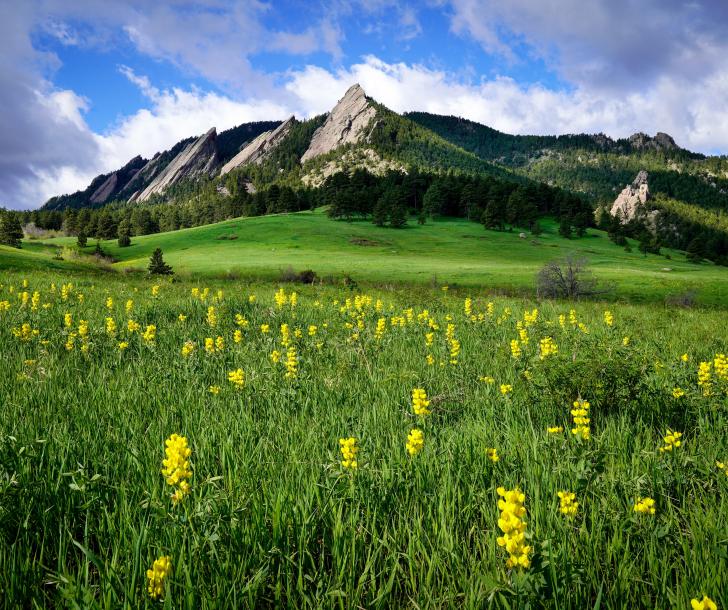
Boulder's Open Space & Mountain Parks are a very special place. The lands teem with native plants and wildlife and are home to threatened and endangered species. They serve as a buffer between Boulder and nearby development. They sustain agriculture uses and add untold benefits to the natural environment - clean air, water, and earth.

The lands shape the urban mosaic of the Boulder Valley and provide citizens with passive recreation opportunities, unique within urban America. One hundred twenty miles of trails are used by walkers, hikers, bicyclists, horseback riders, dog walkers and other passive recreational uses, such as nature study and photography.Boulder's Open Space & Mountain Parks program is the product of a long history of actions taken by the citizens of Boulder to preserve buffer areas, natural areas, and the mountain backdrop. Boulder citizens recognized the value of preserving open space lands as early as 1898, when Chautauqua Park was purchased at the foot of Flagstaff Mountain.
Some Facts About Boulder's Open Space & Mountain Parks
What: Over 45,000 acres of land has been preserved and protected. Wildlife habitat, unique geologic features, greenways and 144 miles of trails are all part of Boulder's Open Space & Mountain Parks. These lands provide scenic enjoyment and passive recreation for area residents.
When: In 1967, Boulder became the first city in the country to pass a sales tax of 0.40% for the acquisition and management of open space lands. An additional 0.33% was approved by the voters in 1989. Boulder citizens recognized the value of preserving open lands as early as 1898, when Chautauqua Park was purchased as mountain backdrop.
Where: Boulder's Open Space & Mountain Parks form a buffer around the city, helping to establish its own, separate identity from neighboring communities. Agricultural lands along the Boulder/Denver Turnpike and the Diagonal Highway provide a scenic entry into Boulder. Mountain backdrop and riparian greenways are also part of Boulder's Open Space & Mountain Parks. The system forms the framework within which development occurs in the Boulder Valley.
How: Through sales tax revenues, bond issues, private donations and development dedications. To date, over 200 million dollars have been spent on the acquisition of open space. Acquisitions are approved by the Open Space Board of Trustees and City Council, with extensive opportunity for public input. Why: To preserve land for scenic, agricultural and buffer value.
Who: You! The people of Boulder, by their support of Open Space & Mountain Parks for over a century. City of Boulder Open Space & Mountain Parks, PO Box 791, Boulder, CO 80306, 303-441-3440.
Open Space and Mountain Parks Mission
The Open Space and Mountain Parks Department preserves and protects the natural environment and land resources that characterize Boulder. We foster appreciation and use that sustain the natural values of the land for current and future generations.
Open Space Charter
The Charter of the City of Boulder describes and mandates the purposes of land acquisition as Open Space (see excerpt below).
- For the complete text of the city charter pertaining to Open Space and Mountain Parks, follow this link.
Sec. 176. Open Space purposes-Open Space land. Open Space land shall be acquired, maintained, preserved, retained, and used only for the following purposes:
- Preservation or restoration of natural areas characterized by or including terrain, geologic formations, flora, or fauna that is unusual, spectacular, historically important, scientifically valuable, or unique, or that represent outstanding or rare examples of native species;
- Preservation of water resources in their natural or traditional state, scenic areas or vistas, wildlife habitats, or fragile ecosystems;
- Preservation of land for passive recreation use, such as hiking, photography or nature studies, and if specifically designated, bicycling, horseback riding, or fishing;
- Preservation of agricultural uses and land suitable for agricultural production;
- Utilization of land for shaping the development of the city, limiting urban sprawl and disciplining growth;
- Utilization of non-urban land for spatial definition of urban areas;
- Utilization of land to prevent encroachment on floodplains; and
- Preservation of land for its aesthetic or passive recreational value and its contribution to the quality of life of the community.
Last Updated on Friday, 18 September 2009 07:58